
Pain Management
Compounded formulations for acute and chronic pain conditions, with a focus on opioid-free topical and injectable options. Multi-agent transdermal creams, trigger point preparations, oral formulations, and nasal sprays configured to each provider's protocol and each patient's plan.

Options Beyond One-Size-Fits-All

Multi-Agent Formulations and Clinical Support
Our pharmacies compound opioid-free and multi-mechanism topical formulations that combine analgesics, anti-inflammatories, muscle relaxants, and neuropathic agents into a single preparation at your specified concentrations. Our clinical team supports you with formulation selection, dermatome-based dosing, and access to clinical education through PharmAcademy.
Become a Provider
Most Commonly Prescribed
Our network of pharmacies compounds a wide range of active ingredients for pain management formulations. Availability of specific formulations varies by pharmacy.
Looking for a specific ingredient or formulation?
Your Revelation pharmacy can confirm current availability and discuss options with your provider.
* Controlled Substance Note: Ketamine is a Schedule III controlled substance. Tramadol and Chloral Hydrate are Schedule IV controlled substances. All are regulated under the DEA Controlled Substances Act. Prescriptions for controlled substances require additional documentation and are subject to applicable federal and state regulations. Contact your Revelation pharmacy for details.
Available Dosage Forms
Compounded pain management formulations are available in multiple delivery methods. Contact your Revelation pharmacy for location-specific availability.
- Intramuscular Injection
- Nasal Spray
- Oral Capsule
- Oral Troche / Lozenge
- Topical Cream
- Topical Gel
- Topical Ointment
- Transdermal Cream
- Trigger Point Injection
Pain Management Education
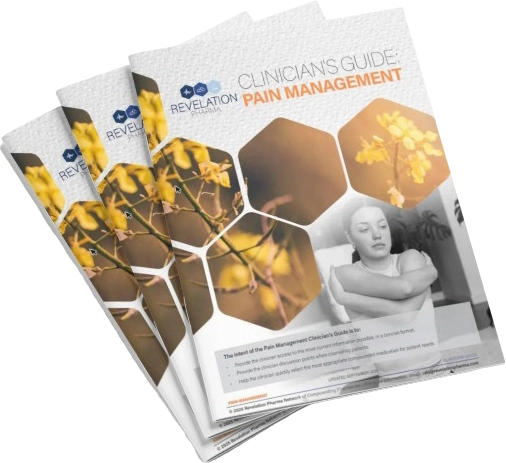
Free clinical education, a clinician’s guide, prescription templates, and condition-specific research materials for pain management compounding. Our course library covers topical formulations, ketamine protocols, low dose naltrexone, neuropathic pain, headache management, and more.
Course Topics Include:
- Clinician’s Guide to Pain Management
- Topical & Transdermal Formulation Overview
- Ketamine Protocols & Nasal Spray
- Low Dose Naltrexone for Pain Conditions
- Inflammation & Chronic Pain
- TBI & PTSD Compounded Protocols
- Prescription Templates (Multiple Pharmacies)
Compounded for Pain Management: What to Know
What is a compounded pain cream?
A compounded pain cream is a prescription topical formulation prepared by a licensed compounding pharmacy that combines multiple active ingredients into a single preparation. Unlike commercially available topicals that typically contain one active ingredient at a fixed strength, compounded creams allow the prescriber to specify the exact combination, concentration, and base for each patient’s condition and treatment site.
Do I need a prescription for compounded pain medications?
Yes. All compounded medications require a valid prescription from a licensed prescriber. Pain management formulations are prepared based on an individual prescription as part of a provider-directed treatment plan.
Are opioid-free compounded pain formulations available?
Yes. Our pharmacies compound a range of opioid-free topical and injectable formulations that combine analgesics, anti-inflammatories, muscle relaxants, and neuropathic agents from multiple pharmacological classes. The prescriber determines the appropriate combination based on the patient’s condition and clinical picture.
Can multiple pain medications be combined into one topical preparation?
Yes. Compounding allows prescribers to combine multiple compatible active ingredients from different pharmacological classes into a single topical cream or gel. For example, a prescriber might combine an NSAID, a muscle relaxant, a neuropathic agent, and an anesthetic in one preparation at custom concentrations. This can simplify the application process for the patient.
What is compounded ketamine used for in pain management?
Ketamine is an NMDA receptor antagonist that prescribers may include in compounded topical, nasal, or oral formulations as part of a pain management protocol. Compounding allows ketamine to be prepared at custom strengths and in delivery methods not commercially available, such as topical creams or nasal sprays. Ketamine is a Schedule III controlled substance and requires appropriate prescriber documentation.
Why Compounding for Pain Management?
01
Opioid-Free Formulations
Multi-mechanism topical and injectable preparations that combine agents from multiple pharmacological classes without the use of opioid ingredients.
02
Multi-Agent Combinations
Analgesics, anti-inflammatories, muscle relaxants, neuropathic agents, anesthetics, and vasodilators combined into a single preparation at the prescriber's specified concentrations.
03
Site-Specific Delivery
Topical and transdermal formulations that deliver medication directly to the treatment site, as directed by the prescriber's protocol.
04
Custom Strengths
Preparations compounded at exact strengths not available commercially, including low dose naltrexone and custom-concentration ketamine formulations.
05
Clinical Pharmacist Support
Our Doctor of Pharmacy team provides formulation consultation, dermatome-based dosing guidance, and clinical education through PharmAcademy.
06
Supplies Available
Syringes, applicators, and other clinical supplies available through Revelation Wholesale.
Disclaimer
All compounded medications require a valid prescription from a licensed prescriber. This content is intended for educational purposes only. It is not medical advice and is not a substitute for a provider’s independent clinical judgment. Compounded preparations require a prescription, and any treatment decision should be based on the individual needs of the patient.
* Ketamine is a Schedule III controlled substance. Tramadol and Chloral Hydrate are Schedule IV controlled substances. All are regulated under the DEA Controlled Substances Act. Additional documentation may be required.
For licensed prescribers only. Fill in your details and we’ll send the guide to your inbox.
By requesting, you agree to receive clinical resources from Revelation Pharma. Unsubscribe at any time.