
What the new enforcement discretion policy means for patients and providers
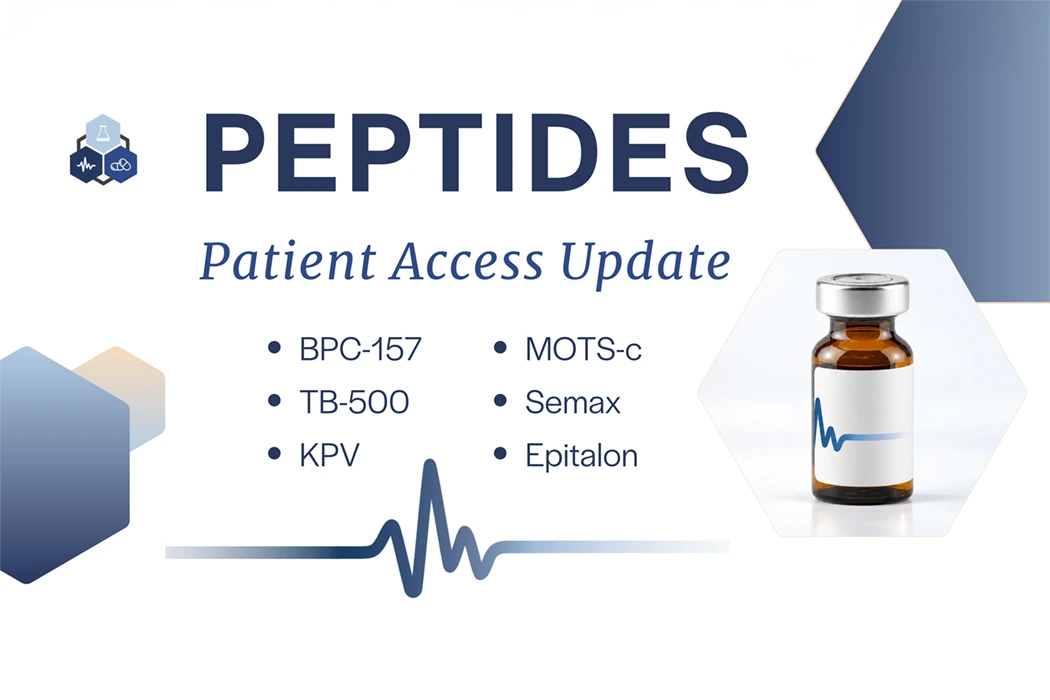
On October 30, 2026, the U.S. Department of Health and Human Services (HHS) published an interim policy that opens a path for 503A pharmacies to compound six peptides:
- BPC-157
- TB-500
- KPV
- MOTS-c
- Semax
- Epitalon
If you followed the Pharmacy Compounding Advisory Committee (PCAC) meeting in July, this is the next development many patients and providers have been waiting on. Below, we break down what the policy means for you and how we’re preparing the next steps.
What “Enforcement Discretion” Means
HHS has said it does not intend to take enforcement action against a state-licensed pharmacy, federal facility, or licensed physician that compounds a drug using one of these peptides. The policy is meant to apply while the 503A Bulks List is developed through rulemaking.
It is not a final approval. FDA’s future rulemakings may propose adding some or all of these peptides to the 503A Bulks List, but that has not happened yet. HHS may also revisit the policy, in whole or in part, if a safety signal or product quality issue arises, and the policy does not create rights for anyone.
The policy lists the covered peptides in an appendix, and its details can limit which forms and routes of administration qualify for each one. A peptide appearing on this list doesn’t mean every preparation of it qualifies, so what a pharmacy can prepare may differ from one peptide to the next. State pharmacy rules continue to apply as well.
What This Means for Patients
For patients, that means getting these peptides from licensed pharmacies, under provider care, instead of research-use-only websites.
Moving peptide access out of unregulated markets and into vetted, licensed pharmacies is a shift worth paying attention to, and it’s a big part of why this policy matters to us. A prescription is still required, and any treatment decision should be based on the individual needs of the patient.
Where Revelation Stands
Our 503A pharmacies have been readying for this moment, and we’re looking forward to serving patients and providers.
Readiness takes more than a policy announcement, though. Our quality teams are working through the steps that are required by HHS’s policy to be in place before our pharmacies compound any of these peptides, including ingredient qualification, testing, and stability review. We’ll share what’s available, and when, as soon as it’s confirmed.
How We Got Here
The July 23-24, 2026 PCAC meeting reviewed seven peptides nominated for potential inclusion on the compounded list. The committee voted to recommend 6 of the 7: BPC-157, KPV, TB-500, MOTS-c, Semax, and Epitalon. Emideltide (DSIP) was the only one not favored for inclusion, and it is not part of this policy.
Before making a recommendation, the committee evaluates each peptide using four key considerations: historical use, characterization, safety, and effectiveness for compounding purposes. Those recommendations were advisory, and the formal route onto the 503A Bulks List still runs through FDA rulemaking.
The Six Peptides at a Glance
Here is what each peptide is and what the committee reviewed it for. This describes regulatory status. It does not make claims about safety or effectiveness beyond what the FDA committee reviewed.
BPC-157 is a synthetic peptide derived from a protein found in human gastric juice. The committee reviewed it specifically for ulcerative colitis. Most available data comes from preclinical and animal studies, and human clinical trial data remains limited.
TB-500 is a synthetic fragment of a naturally occurring protein involved in tissue repair. The committee reviewed it specifically for wound healing. Most available data comes from preclinical and animal studies, and human clinical trial data remains limited.
KPV is a short peptide fragment derived from a larger hormone. The committee reviewed it specifically for wound healing and inflammatory conditions. Most published research comes from preclinical and animal studies, and human clinical trial data remains limited.
MOTS-c is a mitochondrial-derived peptide. The committee reviewed it specifically for obesity and osteoporosis-related conditions. One thing worth knowing: MOTS-c is on the World Anti-Doping Agency’s prohibited list, which came up as a discussion point during the committee’s review. Athletes subject to drug testing should talk with their provider. Most available data comes from preclinical and animal studies, and human clinical trial data remains limited.
Semax is a synthetic peptide derived from a fragment of adrenocorticotropic hormone (ACTH), and most of the research on it was conducted outside the United States. The committee reviewed it specifically for cerebral ischemia (reduced blood flow to the brain). One safety point worth knowing: reviewers flagged signals related to blood clotting effects and interactions with amphetamine-like activity, so this is one where your provider’s guidance will matter. Human clinical trial data meeting FDA’s evidentiary standards remains limited.
Epitalon is a synthetic tetrapeptide modeled on a natural pineal gland compound. The committee reviewed it specifically for insomnia. Because Epitalon affects telomerase, an enzyme involved in maintaining the protective caps on our chromosomes, the FDA noted that current studies aren’t long or large enough yet to fully characterize its long-term safety profile. Most available data comes from a limited number of research groups, and human clinical trial data remains limited.
For Providers: Be Ready When Your Patients Ask
Your patients are already asking about peptides. Two things can help you answer with confidence while our pharmacies finish their preparations.
Join the early access list. Sign up and we’ll send availability updates straight to you as our pharmacies confirm what they can compound, and when.
Learn on demand at PharmAcademy. Revelation Pharma’s complementary learning platform has on-demand peptide webinars you and your team can watch on your own schedule, alongside hundreds of other webinars and clinical articles for providers and their staff. Stay tuned for our peptide course coming soon!
Quality at the forefront. Our quality teams are reviewing each peptide formulation against the HHS policy’s sourcing, testing, and documentation conditions.
Every step in our process supports one goal: helping providers prescribe with confidence.
- Verified ingredients from FDA-registered manufacturers
- Identity confirmed on every raw material lot
- Sterility and endotoxin testing on every sterile batch
- Validated potency and stability methods
- Pharmacist review before every release
Common Questions
Can I get these peptides now?
The policy opens a path, but it doesn’t put peptides on a pharmacy shelf overnight. The HHS policy includes new requirements for Active Pharmaceutical Ingredient (API) suppliers, and Revelation Pharma treats those requirements as a floor, not a ceiling. CGMP-grade peptide API sources are expected to sell material at the start of 2027, and the company’s quality team is actively reviewing qualified suppliers against FDA standards. Revelation Pharma will not rush to market at the expense of quality.
Is this the same as FDA approval?
No. A favorable recommendation does not mean a peptide is appropriate for every patient or immediately available. Enforcement discretion is a decision not to take enforcement action. It does not approve a drug, and compounded drugs do not go through the traditional FDA approval process required for commercially manufactured drugs before they are marketed.
Can I buy peptides online?
You can find them sold online as a “research chemical,” but that market sits outside the licensed pharmacy system. It carries no standardized purity testing, no prescription requirement, and no pharmacist oversight. This policy intends to create a legitimate, regulated space for patients to obtain quality compounded peptides from licensed pharmacies.
Are compounded peptides safe?
Revelation Pharma does not make claims for safety or efficacy of our compounded preparations. Compounded preparations are not FDA-approved, but a lack of FDA approval does not mean compounded preparations are unsafe. What we can tell you is that FDA’s committee reviewed each of these six peptides, that human clinical trial data remains limited for all of them, and that Semax, Epitalon, and MOTS-c each carry specific points worth discussing with your provider. A conversation with a licensed provider is the right place to start.
Will other peptides be reviewed?
Yes. A second PCAC meeting is already scheduled before the end of February 2027 to review five more peptides: Cathelicidin (LL-37), GHK-Cu (injectable), Dihexa acetate, Melanotan II, and PEG-MGF. We will track the movement of these and keep you updated as we know more.
To follow more information about the PCAC meeting, visit: https://www.regulations.gov/document/FDA-2025-N-6895-0001
To read the HHS notice, visit:
https://www.federalregister.gov/d/2026-22192
Information in this post is current as of October 30, 2026.
Revelation Pharma does not make claims for safety or efficacy of its compounded formulations. Compounded preparations are not FDA approved. Compounded preparations require a prescription, and any treatment decision should be based on the individual needs of the patient.